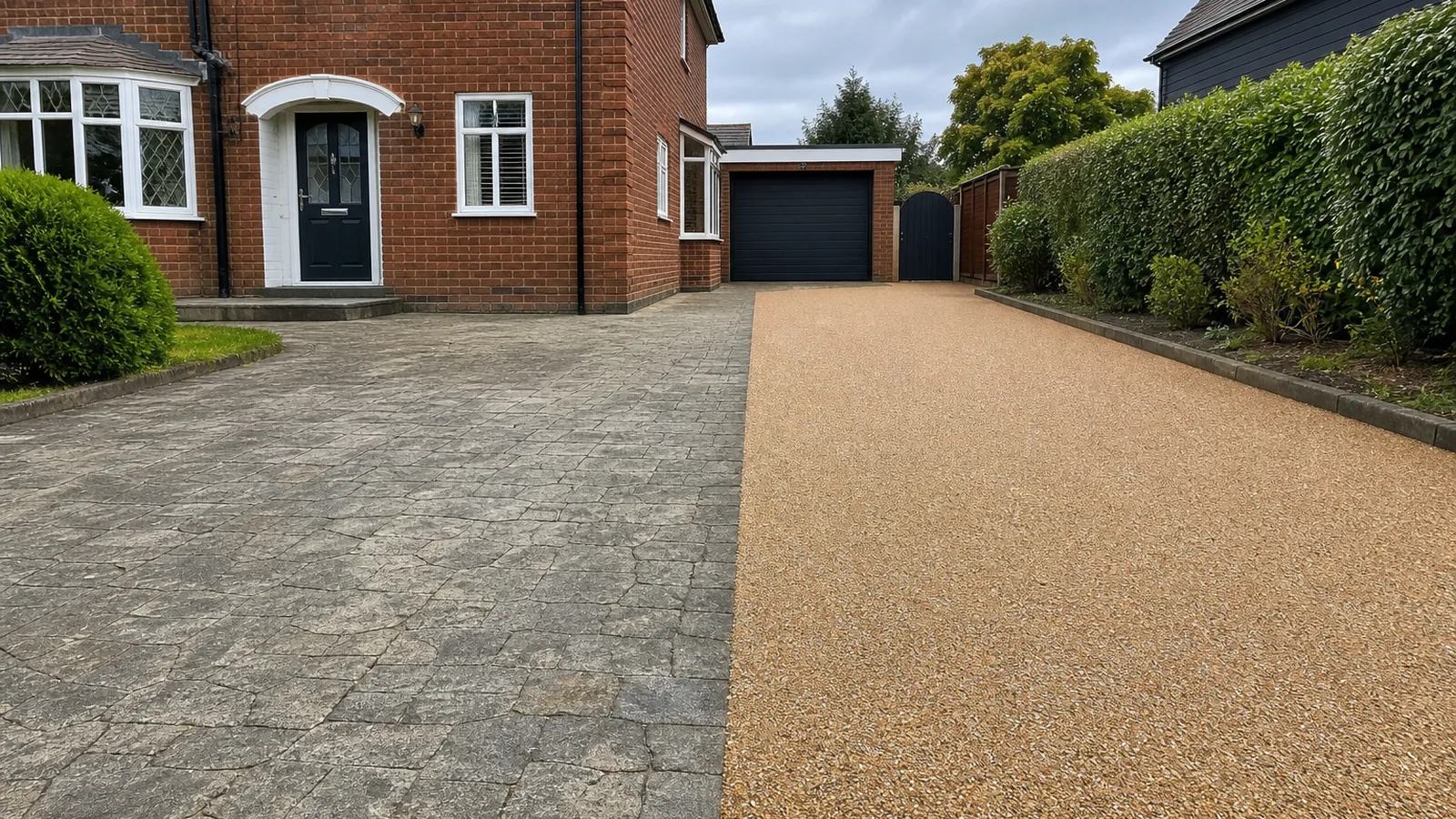
Pattern imprinted concrete (PIC) had its moment in the 1990s and early 2000s, imprinting flagstone and cobble patterns into fresh concrete and staining the top surface. Twenty years on, those drives tell a very consistent story — and it is one worth understanding before choosing PIC today.
How PIC ages
The colour on a PIC drive is a surface stain, applied to the top few millimetres and protected by an acrylic sealer. Once the sealer breaks down — typically 3–5 years — the stain oxidises and fades, and the pattern turns chalky grey. Sealer must be reapplied every 3–5 years for the drive to keep its original look.
By contrast, resin bound uses naturally coloured aggregate all the way through, coated in a clear UV-stable resin. There is nothing on the surface to fade because the colour is the stone itself.
Cracking and repair
PIC is a rigid slab. Ground movement, tree roots and heavy vehicle turning eventually cause hairline cracks that are visually obvious against the pattern and very difficult to repair invisibly. Resin bound is trowelled over a flexible base, tolerates minor movement and can be feathered-in for utility work without a visible seam.
Drainage
PIC is impermeable and typically requires falls, channel drains or a soakaway to comply with SuDS. Resin bound over a permeable base is inherently compliant with no additional drainage design needed on most residential plots.
The verdict
PIC can still look striking for the first few years after a fresh reseal. But most 15-year-old PIC drives look tired and require a sizeable maintenance budget to bring back. Resin bound is a lower-maintenance, better-ageing choice for anyone planning to stay in the property.